
Which competition design is really the best?
Decide objectively – with reliable, AI-backed data instead of intuition.
Today the jury decides with half the picture
A study commission runs for months. At the end, the jury has plans or digital models and a key-figures sheet in front of it; it assesses urban design and architecture, and it does that well. For the measurable criteria, there is no common basis: sometimes the teams calculate themselves, sometimes experts make rough estimates in the preliminary review, sometimes both – each with their own assumptions and method, because robust analyses for every entry would be too expensive and too time-consuming. That does not make the designs comparable. Reliable figures only arrive in late planning phases, when the design is fixed and every correction costs money – so the decisions with the greatest leverage are made on the thinnest basis.
The precision of later planning phases, now in the competition
vyzn takes the client's goals and the competition brief as the benchmark against which every entry is measured. The teams work as before and submit their 2D plans or 3D models. If only 2D plans are submitted, vyzn uses AI to create the 3D model needed for precise simulations and makes it analysis-ready with Deep Model Processing (DMP): it fills in what is missing and brings all entries onto the same data basis. The results reach a precision that was previously out of reach in competitions – and answer what organisers really want to know:
- Cost and space efficiency. Construction costs, comparable team by team – and how efficiently each design uses the site.
- CO₂ and circularity. Emissions from construction and operation across the life cycle – and which materials and systems cause them.
- Energy. Heating demand, compactness of the envelope and solar potential: what operation will cost over decades.
- Comfort. Which rooms are at risk of overheating in summer, by room layout rather than as a flat figure – before a retrofit becomes necessary.
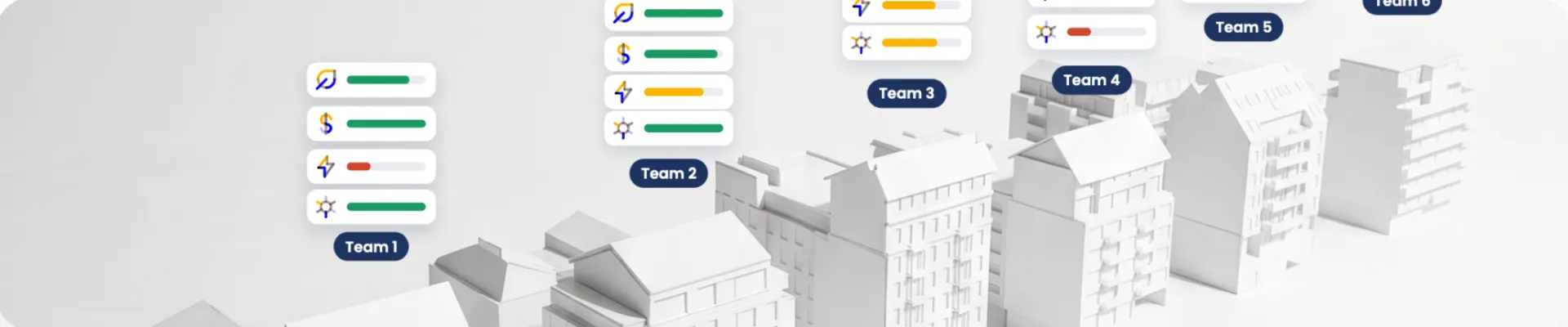
In practice: one competition, six teams
Six designs for a residential project, one brief, one yardstick. Three findings that only a well-founded decision basis made visible:
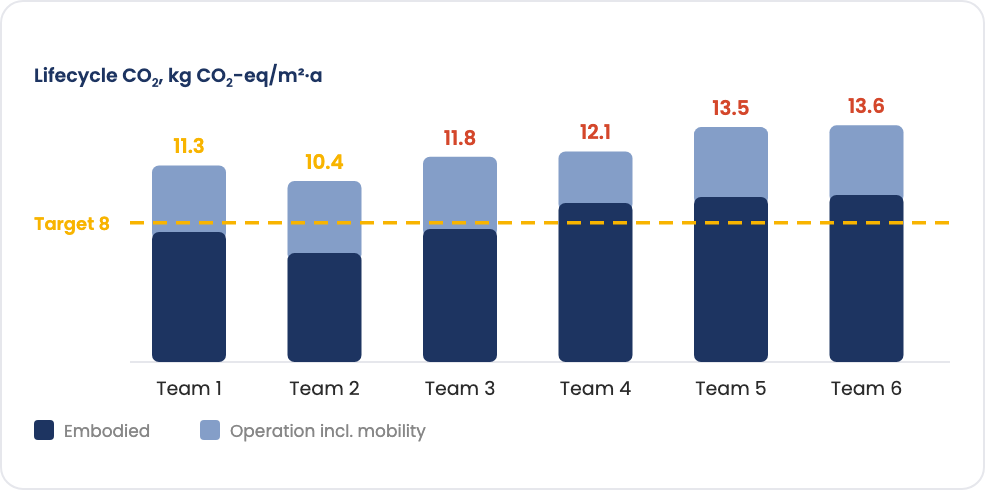
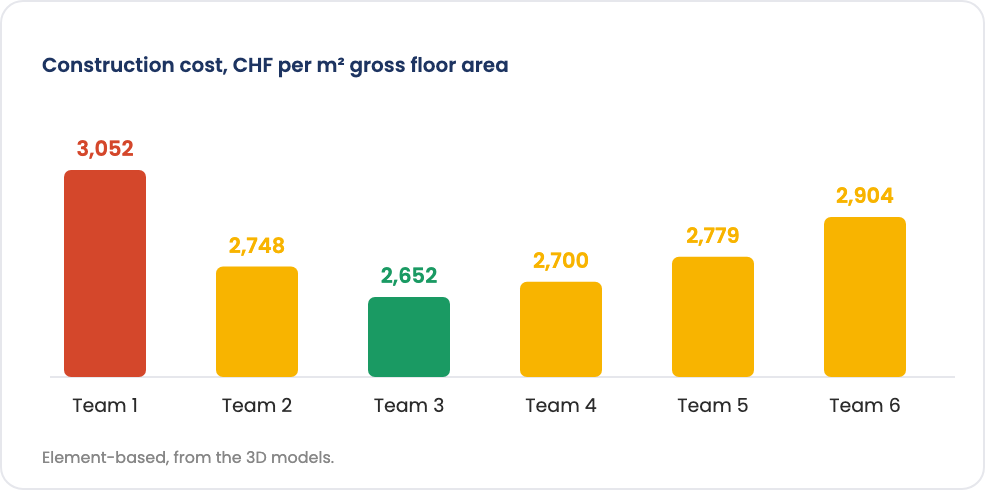
Transparency that carries the decision
- Everything visible in the 3D model. Building elements and materials, building services, room layout and more are visible directly in the 3D model. The jury and experts can check every value instead of having to take it on trust.
- Answers in seconds. The vyzn Assistant answers any question about the project from the data – for example, which team has the lowest operational CO₂ and why.
- A decision basis to take away. An exportable report for the jury session and the committees that follow.
Trust in the teams, backed by evidence
The analysis also shows how carefully a team has worked: whether the brief has been met and how complete and consistent the plans and 3D model are. Anyone who will work with a design team for years after the competition wants to know whether it holds high standards – and has the evidence at hand.