vyzn at Swissbau: Is gut feeling enough for the best project variant?
In the early planning phase of a real estate project, central course-settings are made for CO2 emissions, energy efficiency, comfort and costs. But what are these decisions actually based on? Is experience enough to reliably assess the performance of a building?
At this year's Swissbau, we put it to the test.
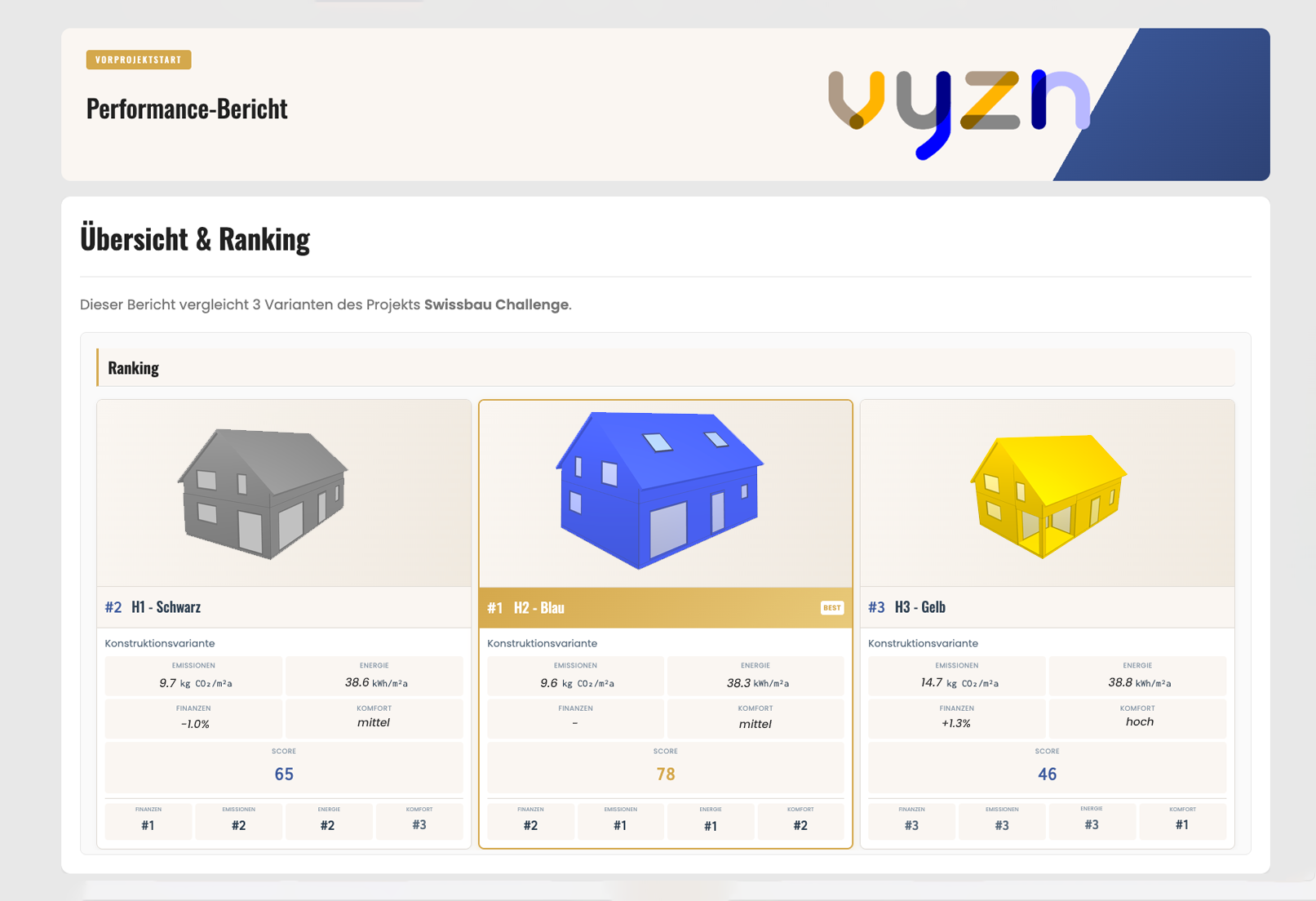
The challenge: 3 models, 4 metrics, 1 goal
At our booth, we presented three project variants – as 3D-printed models to touch and compare.
Which variant performs best in the areas of:
- Emissions (LCA / embodied energy)
- Energy efficiency (heating demand)
- Comfort (summer thermal protection)
- Costs (according to e-BKPH)
In addition, there was the option to combine the ground floor, upper floor and roof, thus forming a new, optimized overall variant.
When experience reaches its limits
It was fascinating to observe: what was planned as a "quick look" turned into an intensive variant study for many. One participant spent almost a whole hour comparing the models, analyzing facade structures and getting into the technical details of thermal mass.
This shows: even for professionals, it is difficult to correctly assess the complex interactions between material choice, window proportion and costs purely visually or intuitively.
The resolution: data instead of assumptions
The three variants were evaluated directly from the digital building models with the vyzn software. The calculation was carried out automatically, standard-compliant and within a few minutes.
The result was extremely close. The analysis clearly showed that the optimum often lies in the combination. The "winning variant" for overall efficiency was a mix: the ground floor of the black model combined with the upper floor and roof of the blue model.
The winners
Only a few participants managed to assess all metrics exactly right. We tip our hats to:
- The team from the Schindler Group (Anna, Sebastian, Miguel & Lukas)
- Chris from Enerhaus Web Services GmbH
Your bottles of sparkling wine are the well-deserved reward for your analytical eye!
Conclusion: what we take away from the challenge
The challenge made clear that the best solution is rarely obvious. The optimum lay not in a single variant, but in a combination.
Intuition and experience remain important components of planning. But with several conflicting goals at once, even experienced experts reach their limits. A structured, data-based analysis creates transparency and comparability here.
The goal is not to replace gut feeling, but to complement it. This makes it possible to make well-founded decisions as early as the preliminary project, before adjustments become laborious or costly.
Would you like to see what the analysis looked like in detail? Watch the video with our COO Martino here, in which he explains the background to the challenge:
Video: https://youtu.be/kHdPmfRPG5I